
 In-Service Corrosion Mapping & Thickness Profiling
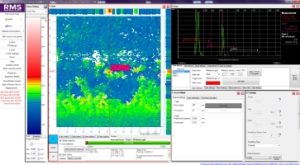
Westech Inspection, Inc. utilizes advanced automated ultrasonic scanning systems to perform high-resolution C-Scan corrosion mapping on tanks, pressure vessels, and piping while equipment remains in service.
Our computer-controlled magnetic crawler system provides over 250 lbs of magnetic holding force and can be configured for multiple geometries and orientations. Because the crawler can be remotely steered, large inspection areas can be examined without scaffolding, rope access, or extensive entry requirements.
The result is a safer inspection with significantly more data and higher reliability compared to manual spot ultrasonic thickness readings.
Why Automated C-Scan Instead of Manual UT?
Traditional thickness readings provide isolated data points. Automated scanning produces a complete mapped profile of the component.
Benefits include:
Large area corrosion mapping rather than isolated spot readings
Identification of localized corrosion and pitting
Improved remaining life calculations
Reduced access requirements and downtime
Digital records for trending and future comparison
This allows owners and engineers to make maintenance decisions based on actual condition rather than limited sampling.
High-Resolution Imaging Capabilities
Standard Resolution Scanning
0.25 in × 0.25 in grid spacing
Rapid coverage of large surface areas for general corrosion assessment and screening.
High-Resolution Scanning
0.05 in × 0.05 in grid spacing
Detailed imaging capable of revealing fine corrosion contours, localized pitting, and small defect features.
B-Scan & Data Interpretation
Each C-Scan image is supported by full B-Scan cross-sectional data.
By scrolling through the collected scan lines, our technicians can:
Classify corrosion mechanisms
Differentiate laminations from metal loss
Accurately size defects
Verify minimum thickness locations
Confirm data reliability for engineering calculations
This is critical when performing remaining life or MAWP calculations, where inaccurate readings can lead to overly conservative repairs — or unsafe continued operation.
Typical Applications
Pressure vessel shell corrosion mapping
Tank shell and floor plate evaluation
Exchanger shell internal corrosion
Piping corrosion under insulation screening areas
Fitness-for-service assessments
Reliable Data for Engineering Decisions
Automated ultrasonic mapping provides the detailed thickness profile required for defensible engineering evaluations and mechanical integrity programs. Instead of estimating condition between measurement points, you receive a full visual representation of the component’s actual remaining material.